Velvet Width: 160 cm Roll Halves Cloth at 80 cm but Wins at Only Four of Fifteen Widths
Zhuji, China - November 13, 2026 - Shaoxing Mujia Textile has added a 160 cm velvet width for the scarf and abaya end of the range, halving the cloth consumed per garment panel at an 80 cm cut width and leaving 12.5 percent of the roll unused at 70 cm. Across fifteen panel widths the wider roll wins at four and saves nothing at the other eleven, which is why the number on a quote can differ from the number on a cost sheet.
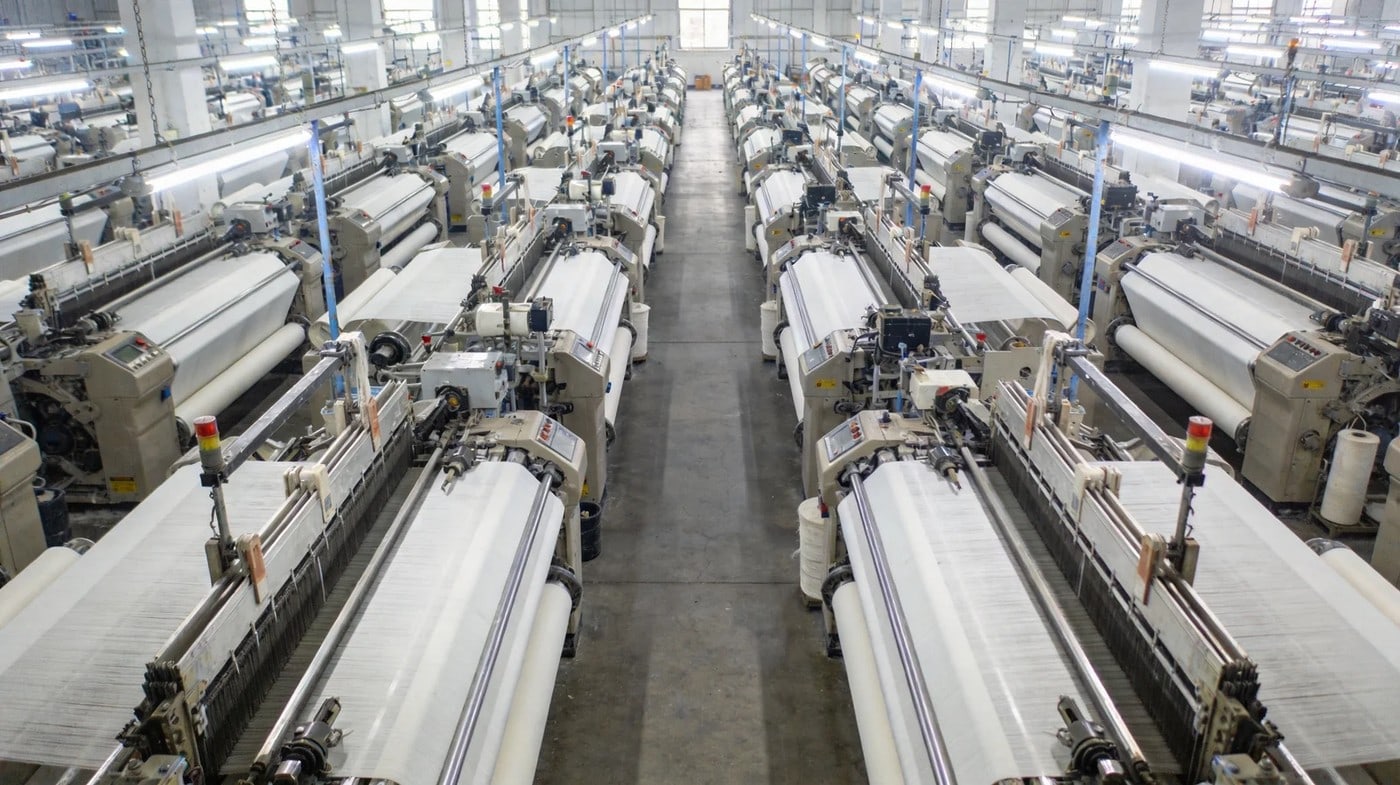
The comparison was run on a single velvet construction, 80 percent viscose and 20 percent nylon, woven at both widths on the same air-jet looms, and published by Shaoxing Mujia Textile Co., Ltd. alongside the addition of the 160 cm width to its range.
Cutting yield is the panels that fit across a roll, times the panel width, divided by the roll width. What remains at the selvedge, the woven edge of the roll, is waste, and on a garment panel it is not recoverable. The comparison covers panel widths from 45 cm to 160 cm, and every width in it is a cut width; the full table is published at mujiatextile.com. A finished 77 cm panel takes an 80 cm cut once 1.5 cm of seam allowance is added on each side; at 83 cm the 160 cm roll fits one panel rather than two, which is why the comparison is built on cut width and not on finished size.
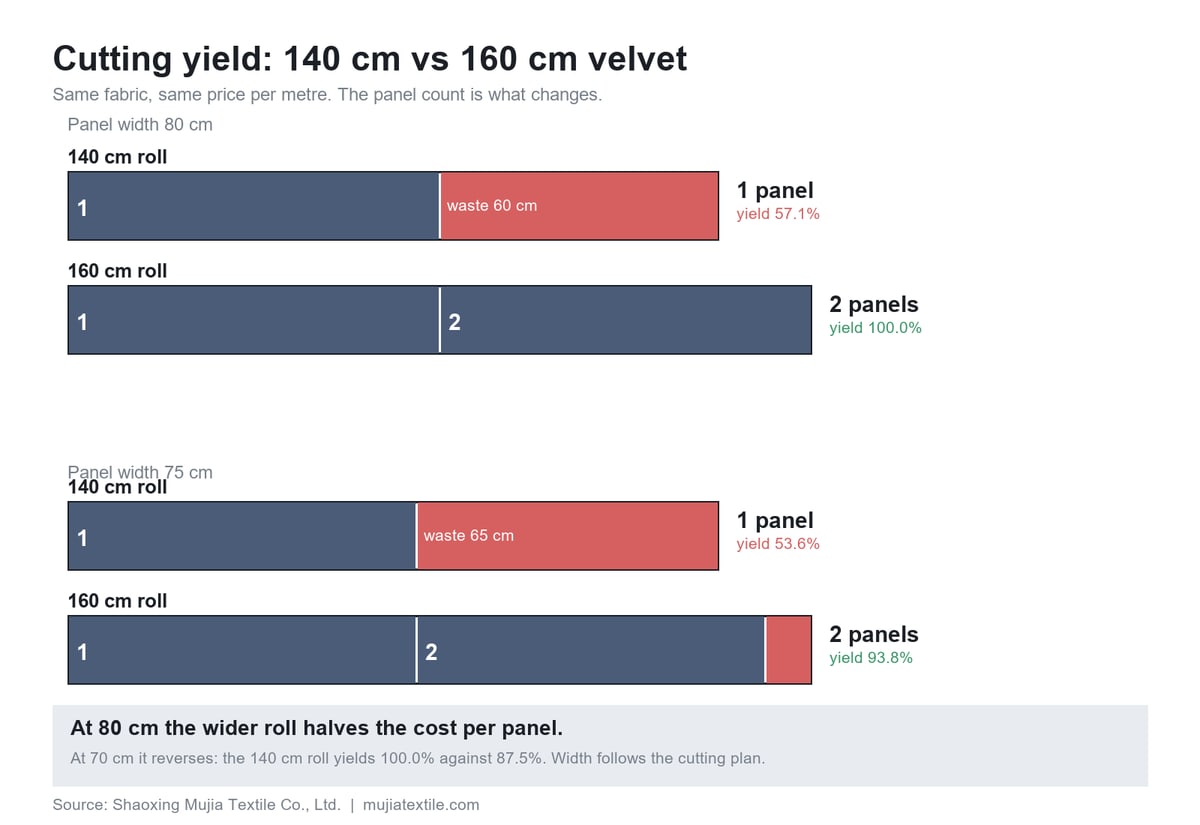
At 80 cm, a 140 cm roll carries one panel across and leaves 60 cm, 43 percent of the roll, so an 80 cm panel consumes a full metre of cloth. A 160 cm roll carries two panels with nothing left over, so the same panel consumes half a metre. At an equal price per metre, the cost per panel halves. This is the widest gap in the set.
At 70 cm the result reverses. A 140 cm roll carries two panels with nothing left over, a yield of 100 percent. A 160 cm roll carries two panels and leaves 20 cm, a yield of 87.5 percent. A 70 cm panel uses the same half metre on both rolls; the wider width saves nothing here and carries 20 cm of selvedge waste on every metre.
Between those two figures the change is abrupt. At 75 cm a 140 cm roll carries one panel and leaves 65 cm, a yield of 53.6 percent. A 160 cm roll carries two and leaves 10 cm, a yield of 93.8 percent. Seven centimetres of panel width separates a loss from a gain.
A second band runs the other way. At 50 cm a 140 cm roll carries two panels and leaves 40 cm, a yield of 71.4 percent. A 160 cm roll carries three and leaves 10 cm, a yield of 93.8 percent. The gain comes from one more narrow panel, not a wider one.
Between 55 cm and 65 cm the narrower roll holds a smaller advantage. At 60 cm a 140 cm roll carries two panels and leaves 20 cm, a yield of 85.7 percent; a 160 cm roll carries two and leaves 40 cm, a yield of 75 percent. At 55 cm the figures are 78.6 and 68.8 percent, and at 65 cm 92.9 and 81.2 percent. Across 55 to 70 cm the 140 cm roll leads by 9.8 to 12.5 percentage points, and in relative terms the penalty is the same 14.3 percent at every one of those widths, because both rolls carry two panels and the wider one holds a constant 20 cm of waste.
From 90 cm up both rolls carry one panel through to 140 cm, so at an equal price per metre the cost per panel is identical and the wider roll again pays for 20 cm that carries nothing. At 100 cm the 140 cm roll leaves 40 cm and the 160 cm roll leaves 60 cm. At a 140 cm panel width the 140 cm roll returns 100 percent and the 160 cm roll returns 87.5 percent. At a 160 cm panel width the 140 cm roll cannot carry the panel at all, so cost is not the question.
For that end of the range a panel wide enough to cut in one piece decides whether a garment carries a seam down the centre. At 140 cm an abaya body takes a full metre of cloth and leaves 60 cm unused; at 160 cm it takes half a metre, provided the panel is drawn at 75 to 80 cm.
"Buyers compare price per metre because that is the number on the quote," says Zhou Jia, founder and director of Shaoxing Mujia Textile Co., Ltd. "The number that reaches the cost sheet is price per panel, and it depends on width. Two mills can quote the same price per metre, and at some panel widths the cost per panel differs by half."
Where a buyer lands depends on what is being cut. In the company's experience, hijab panels vary with the wrap, from about 70 cm on a narrow style to around 180 cm on a long one, beyond the widths compared here. The narrow end sits where the two widths behave the same; the long end is past both rolls, and a panel that wide has to be joined or cut from wider stock. A dirac is a straight-cut dress. An abaya is a long robe worn across the Gulf and the Horn of Africa. Both are usually cut in the 75 to 80 cm band, where the wider roll returns 93.8 to 100 percent against 53.6 percent at 75 cm.
A further consideration sits behind the panel width. Finished width and usable width are not the same number, and the trade quotes the first while the cutting table works from the second. The width on a roll is measured between the selvedges, and the width a cutter can use is smaller by the selvedge itself and by whatever the finishing process pulled in. A roll described as 160 cm may give a usable width several centimetres narrower, and a cutting plan built on the finished figure runs short on the last panel.
Three figures decide whether a wider roll helps: the usable width as distinct from the finished width, and whether both are stated; the width tolerance, because a roll that arrives two centimetres narrow changes the panel count on every metre; and what the mill holds at that width, because a width woven to order carries a minimum that a stock width does not.
About Shaoxing Mujia Textile Co., Ltd.
Founded in 2012 and registered in Zhuji, Zhejiang, Shaoxing Mujia Textile Co., Ltd. runs 30 Lenado air-jet looms in a 5,000 square metre plant and produces about five million metres of woven fabric a year. The company weaves in Fengqiao and works with partner mills for dyeing and finishing. Full specifications are at mujiatextile.com. Loom-floor footage is at youtube.com/@MujiaTextile-h2d.