
Two Lots of the Same Commercial Albumin Differed 5.5-Fold in Endotoxin, and the Immune Response Followed the Endotoxin, Crescent Bioresearch Examination Shows
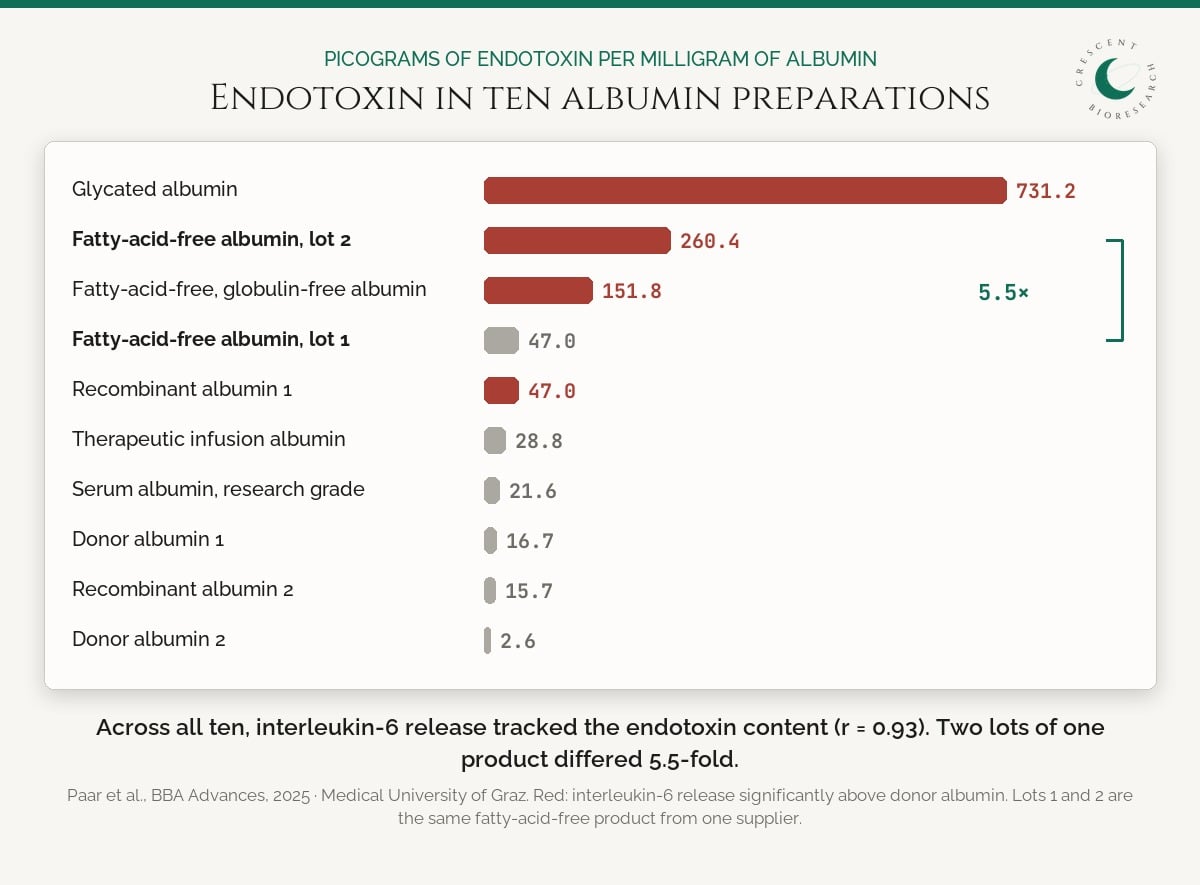
ALBANY, N.Y., Oct. 20, 2026 -- Two containers of the same research-grade albumin, sold under one product number, were found to carry 47.0 and 260.4 picograms of endotoxin per milligram of protein. The gap was 5.5-fold, and the response of human blood cells to the two lots followed it. That observation is one of several in a 2025 study in BBA Advances from the Medical University of Graz, which Crescent Bioresearch, a supplier of laboratory compounds, has examined for what it demands of an endotoxin certificate. The demand is a figure for every sample, because the study's most important correction could not have been made without one, and because the endotoxin field on a typical certificate of analysis supplies no figure at all.
Lipopolysaccharide, the endotoxin of Gram-negative bacteria, is present wherever those organisms have been, and purified or recombinant proteins carry it unless it has been removed. The Limulus amebocyte lysate assay quantifies it, and the Graz investigators expressed it in picograms per milligram of protein, a unit that can be compared across preparations, divided, and entered into a calculation. The study turned on all three operations.
Ten preparations, four properties
Albumin is the most abundant protein in human plasma and is in daily use in clinical and research settings alike. Earlier reports had linked particular forms of it to immune stimulation, among them albumin partly oxidized at its single free cysteine and albumin modified by glucose, the form that accumulates in the blood of people with diabetes. The Graz group, working across the Medical University of Graz and the University of Graz, assembled ten human albumin preparations, from therapeutic infusion solution to commercial research grades, and characterized each for four properties: oxidation state, degree of glycation, fatty acid load and endotoxin content.
Each preparation was then added to freshly isolated human blood immune cells, with release of the inflammatory signal interleukin-6 as the readout, and to reporter cell lines engineered to signal when the innate immune receptors TLR4 or TLR2 are activated.
The response followed one of the four
The therapeutic albumin produced no interleukin-6 and activated neither receptor. Several research-grade products, among them fatty-acid-free, glycated and recombinant preparations, induced substantial interleukin-6 release and activated both receptors. Across the ten, interleukin-6 release correlated with endotoxin content at a coefficient of 0.93. Fatty acid load and degree of glycation showed no consistent relationship with the response.
The glycated product carried 731.2 picograms of endotoxin per milligram, the highest of any commercial albumin tested. When the investigators glycated low-endotoxin albumin themselves, to the same degree as that product and well beyond it, the result produced no interleukin-6 and no receptor activation. Low-endotoxin albumin heavily loaded with fatty acids, and low-endotoxin albumin prepared in its reduced and oxidized forms, were likewise inert.
One product number, two materials
The two lots of fatty-acid-free albumin from a single supplier were the clearest illustration. At 47.0 picograms per milligram, the first lot did not reach a significant interleukin-6 response. At 260.4, the second did. Nothing on the label distinguished them. The authors observed that information on contaminants in research-grade albumin is often not provided, and recommended that each product be systematically characterized before use.
A correlation that did not survive a control
Early in the analysis, the share of albumin in its reduced form appeared to protect against inflammation, correlating with lower interleukin-6 release. Reported on its own, that would have stood as a property of the protein's chemistry. The reduced form, however, also tracked endotoxin content. When the investigators held endotoxin constant in a partial correlation, the protective relationship vanished, and direct testing of low-endotoxin reduced and oxidized albumin confirmed that oxidation alone did not trigger the response.
A partial correlation requires a value for every sample. The correction was available to the Graz group because each of the ten preparations carried a measured endotoxin figure. Had the preparations arrived with a word in the endotoxin field, the confounding variable would have had no value to hold constant, the apparent protection would have survived, and a property of the protein would have entered the literature where the cause was a contaminant the certificate never quantified.
The authors recorded the limits of their work: isolated human cells and reporter lines, substantial variation between blood donors, and a four-hour exposure that may have been too short to capture slower activation by fatty acids. The response to the endotoxin-bearing preparations stood out in every experiment regardless.
What the study asks of a certificate
Three operations made the Graz findings possible. The investigators compared endotoxin across preparations, which requires a figure in a common unit. They divided it per milligram, which requires a figure and a mass. They entered it as a control variable, which requires a figure for every sample. A certificate reporting pass or fail permits none of the three. It reports that a laboratory compared an unseen value against an unseen limit, and it leaves the research entity holding the material with no way of repeating the comparison or of carrying the value into its own analysis, as the Graz group carried theirs.
"An effect of the protein's chemistry appeared in the data, and it was dismantled only because the investigators held a measured endotoxin figure for every preparation and could account for it," Crescent Bioresearch said. "Two lots under one product number differed more than five-fold, and measurement alone revealed it. A certificate that reports a pass in place of the number has removed the tool that exposed the error, and a result attributed to the wrong cause does not stay in one laboratory. It enters the literature, and the literature is where it has to hold."
METHODOLOGY
This examination is based on Paar M, Fengler VH, Schweiger M, et al., "Albumin does not induce IL-6 release and toll-like receptor activation in vitro: Role of endotoxin contamination and biochemical modifications," BBA Advances 2025;8:100174.
ABOUT CRESCENT BIORESEARCH
Crescent Bioresearch is a supplier of laboratory compounds, founded around a framework of critical assessment. It works with research entities nationwide in pursuit of preserving the integrity of scientific research through its transparency approach. Follow the Crescent Discovery Series to dive into the latest breakthroughs and findings within prominent literature.
Find Crescent Bioresearch on Instagram, TikTok, X and Facebook, and every certificate we publish, at https://crescentbioresearch.com/kooajj