
The Great Morph reaches no. 1 on Amazon Kindle, exploring shift in customer behavior

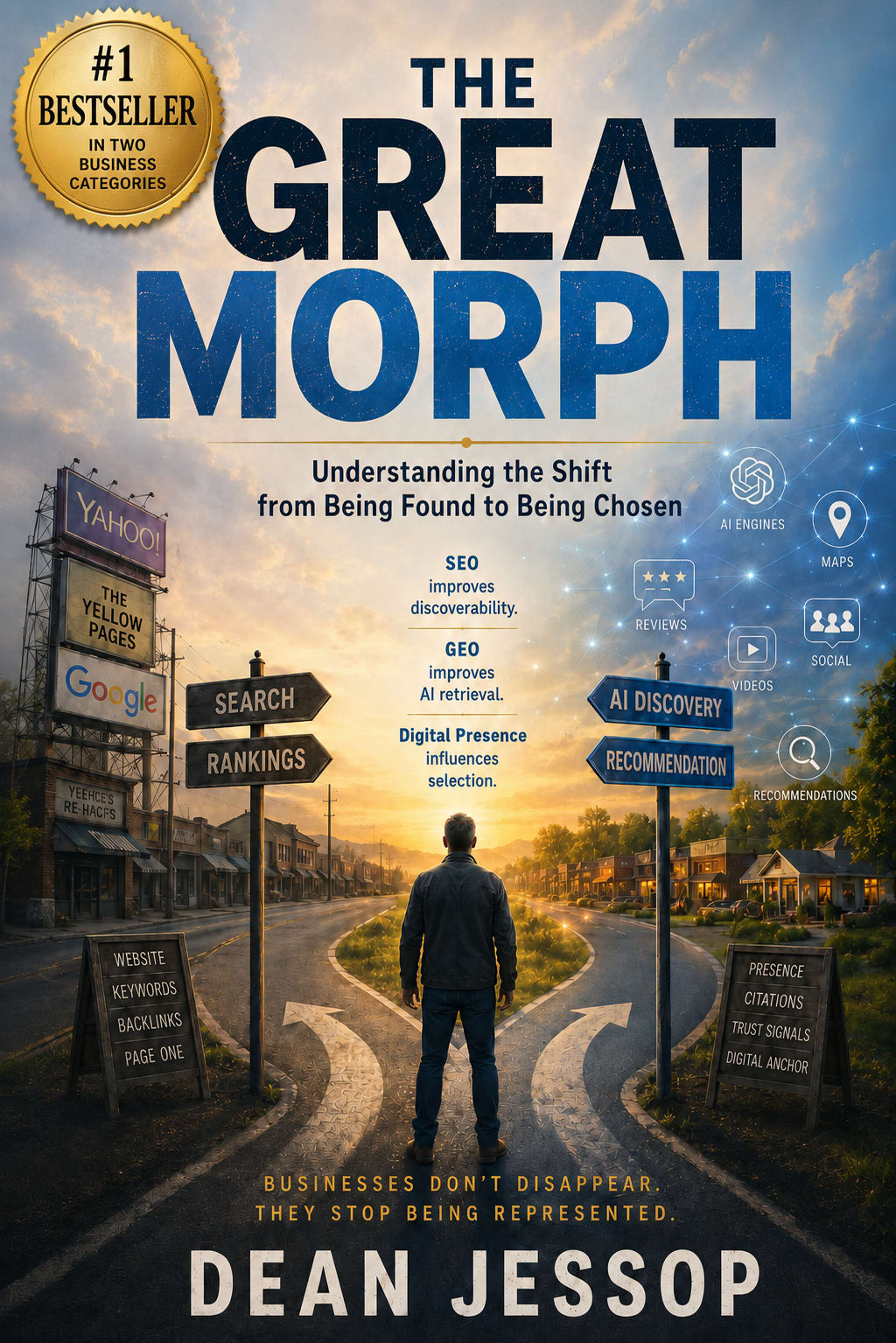
The Great Morph: Understanding the Shift from Being Found to Being Chosen, by Canadian entrepreneur and author Dean Jessop, reached No. 1 in two Amazon
Kindle categories and No. 1 among Amazon Hot New Releases in Web Marketing.
The book reached No. 1 in Business Systems & Planning, No. 1 in Systems & Planning and No. 2 in Information Management. During its bestseller run, The Great Morph also rose into approximately the top 0.1% of the Kindle marketplace, which contains millions of titles.
The success of the book comes as small-business owners face an important change in how new customers are trying to find them.
More than 40% of Canadian web traffic now comes from mobile phones. However, the bigger change is not simply that people are using their phones. It is how they are using them.
Instead of typing a few words into Google and reviewing pages of businesses, more people are asking their phones complete questions and expecting the phone to provide an answer or a few recommendations.
A customer may ask for a contractor who works in a particular area, a mortgage broker who understands a difficult application, a restaurant suitable for a specific occasion or a local company that can solve an immediate problem.
The customer may speak or type the question, but the expectation is increasingly the same: understand what is needed and provide the best available answers.
“That is the change business owners need to understand,” Jessop said. “New customers may be asking their phones for an answer rather than searching through pages of businesses. Owners need to understand how those customers are trying to find them and adjust their marketing accordingly.”
The Great Morph was written for regular business owners trying to understand how AI search is changing the way they get new customers.
The marketing industry may use terms such as GEO, AI search and AI visibility to describe the change, but the business issue is much simpler.
When a new customer asks their phone for a product or service, a business must be understood and verified well enough to be included among the answers—or the customer may never know it exists.
The title of the book reflects this shift from simply being found online to being understood, presented and ultimately chosen.
For years, business owners have concentrated on being found through Google. That remains extremely important. Google, search engine optimization and accurate online information continue to provide the tracks and foundation on which much of AI search is built.
The additional consideration is what happens when a customer asks their phone a question and receives only a few answers instead of pages of businesses to investigate.
“Business owners have spent years being told they need to be found on Google. That advice is still very important,” Jessop said. “But now there is another question: when a new customer asks their phone for a business like yours, does the phone understand your company well enough to include it as one of the answers? A business cannot be chosen if the customer is never shown it as an option.”
The difference is especially important when businesses are trying to attract customers who do not already know their names.
An existing customer may search directly for a company. A new customer is more likely to describe a need, explain a problem or ask for a recommendation without naming a specific business.
The phone may then provide one, two or a small number of possible choices.
A company could therefore have years of experience, excellent customer relationships and a strong reputation in its community, but still be overlooked if the AI system answering the question cannot confirm what the business does, where it operates or whether it is relevant to the customer’s request.
“A business can be online, experienced and possibly one of the best in its field, but still not be the answer,” Jessop said. “If the AI system responding to a new customer’s question cannot verify the business, that customer may never know the company was available for them to contact.”
The Great Morph explains why businesses need clear, accurate and consistent information available wherever customers, Google and AI systems may look for it.
The book does not expect business owners to become programmers, AI specialists or search experts. Instead, it helps them recognize how customer behaviour is changing and why that change must now be considered as part of their marketing.
“This is not about adding more technical language to a business owner’s day,” Jessop said. “It is about understanding the person holding the phone. That person may be a new customer who is ready to buy, but the business first has to become one of the answers they are given.”
The change may be particularly important for small and local businesses.
Large national companies often have extensive advertising, media coverage and information published across many online platforms. A smaller business may have decades of experience and be highly respected locally while having much less information available for search engines and AI systems to verify.
The quality of the company’s work may not be the issue. The challenge may be that its real-world experience and credibility are not represented clearly enough online.
The ideas explored in The Great Morph are also connected to Jessop’s work as Founder and CEO of IRefer Club, a Canadian business-visibility platform created to help small and local businesses get in front of new customers using Google, AI and other search options.
IRefer Club verifies and publishes approved information about participating businesses, including what they do, where they operate and how customers can contact them. This gives Google, AI systems and other search platforms clearer access to information they can understand and use.
The platform supports the business’s existing marketing while helping it become more visible to customers who may be asking their phones for answers.
“The Great Morph explains what is changing,” Jessop said. “IRefer Club was created to help small businesses respond to that change without expecting the owner to become an expert in AI or search.”
About Dean Jessop
Dean Jessop is a Canadian entrepreneur, No. 1 bestselling author, keynote speaker and Founder and CEO of IRefer Club. His work focuses on helping businesses understand how changing customer behaviour, mobile search and AI are affecting the way new customers find and choose them.
Interview and Media Inquiries
Amanda Wall
IRefer Club
Email: [email protected]
Phone: +1 833-473-3378
Official book website:
https://thegreatmorph.com
The Great Morph on IRefer Club:
https://www.ireferclub.com/the-great-morph/
Dean Jessop on LinkedIn:
https://www.linkedin.com/in/deanjessop