
Physical AI Market to Surge 16.5-Fold to $82.79 Billion by 2035, Driven by Industrial Automation and Edge Computing
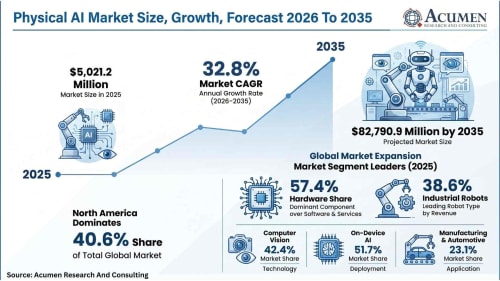
NEW YORK — March 20, 2025 — The global physical AI market is projected to expand from $5.02 billion in 2025 to $82.79 billion by 2035, representing a compound annual growth rate (CAGR) of 32.8%, according to a new report from Acumen Research And Consulting. This growth translates to a 16.5-fold increase over the decade, fueled by rising adoption of industrial automation, advances in robotics, and demand for autonomous systems.
Physical AI encompasses artificial intelligence systems capable of perceiving, reasoning, and interacting with the physical world through sensors, computer vision, machine learning, robotics, and autonomous decision-making. Key applications include humanoid robots, autonomous mobile robots, self-driving vehicles, smart factories, AI-powered drones, and industrial robotic systems.
On-device deployment accounted for more than half of market revenue in 2025, driven by benefits such as lower latency, enhanced privacy, improved reliability, and reduced cloud dependency. The expansion of edge AI computing is a significant contributor to this trend.
North America held the largest market share at 40.6% in 2025, supported by robust AI investments, advanced manufacturing infrastructure, and the presence of major technology firms. Asia-Pacific is expected to witness the fastest growth, propelled by rapid industrialization, smart factory initiatives, and increasing robotics adoption in China, Japan, and South Korea.
Key players in the physical AI market include NVIDIA Corp., Tesla Inc., ABB Ltd., Siemens AG, Boston Dynamics, Agility Robotics, Figure AI, Hyundai Robotics, FANUC Corp., KUKA AG, Omron Corp., Rockwell Automation, Universal Robots, and Amazon Robotics.
NVIDIA has introduced Cosmos, a platform of world foundation models for robotics and autonomous systems, and expanded its Omniverse platform to support industrial digital twins, synthetic data generation, and robotic simulations. The company has announced partnerships with Siemens, Accenture, Microsoft, Ansys, and Cadence to accelerate adoption of physical AI solutions.
Despite the optimistic outlook, the market faces challenges including high development costs, safety and regulatory concerns, and the need for large training datasets. Organizations are increasingly turning to synthetic data and simulation technologies to address data requirements.