PhAI Labs releases ScienceBuddy Preview, a scientific AI workspace designed to learn from researchers

PhAI Labs has released ScienceBuddy Preview, a browser-based research workspace that brings papers, tables, biological sequences, and scientific images into one environment. Researchers can ask questions in natural language and review the analysis, tool activity, and source records behind each response. ScienceBuddy Preview is available at science-buddy.io, where researchers can request access, and the interface is available in English and Chinese. The technical report is published on arXiv and the research code is on GitHub.
ScienceBuddy is designed to improve through researcher collaboration. It converts requests, feedback and execution records from research sessions into scientific tasks and evaluation criteria, which are then used to refine both the software procedures that guide the AI agent and the model that carries out the work.
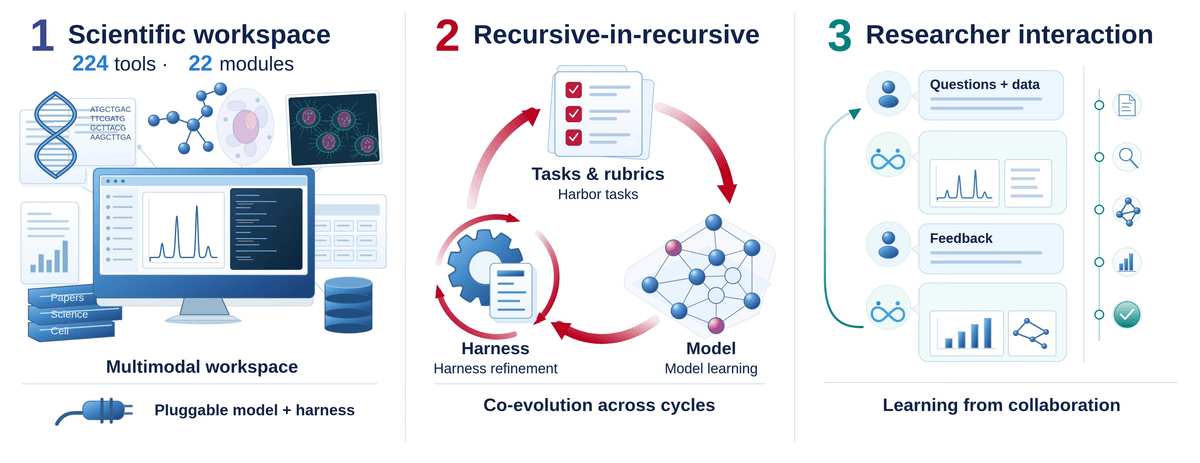
ScienceBuddy combines researcher dialogue, scientific tools, execution records, and analysis artifacts in one persistent workspace. It includes 224 tools across 22 functional modules spanning genomics, molecular and cancer biology, pharmacology, bioimaging, literature retrieval, and database queries. Although its input and document workflows support multiple scientific domains, its current tools and data focus on biomedicine.
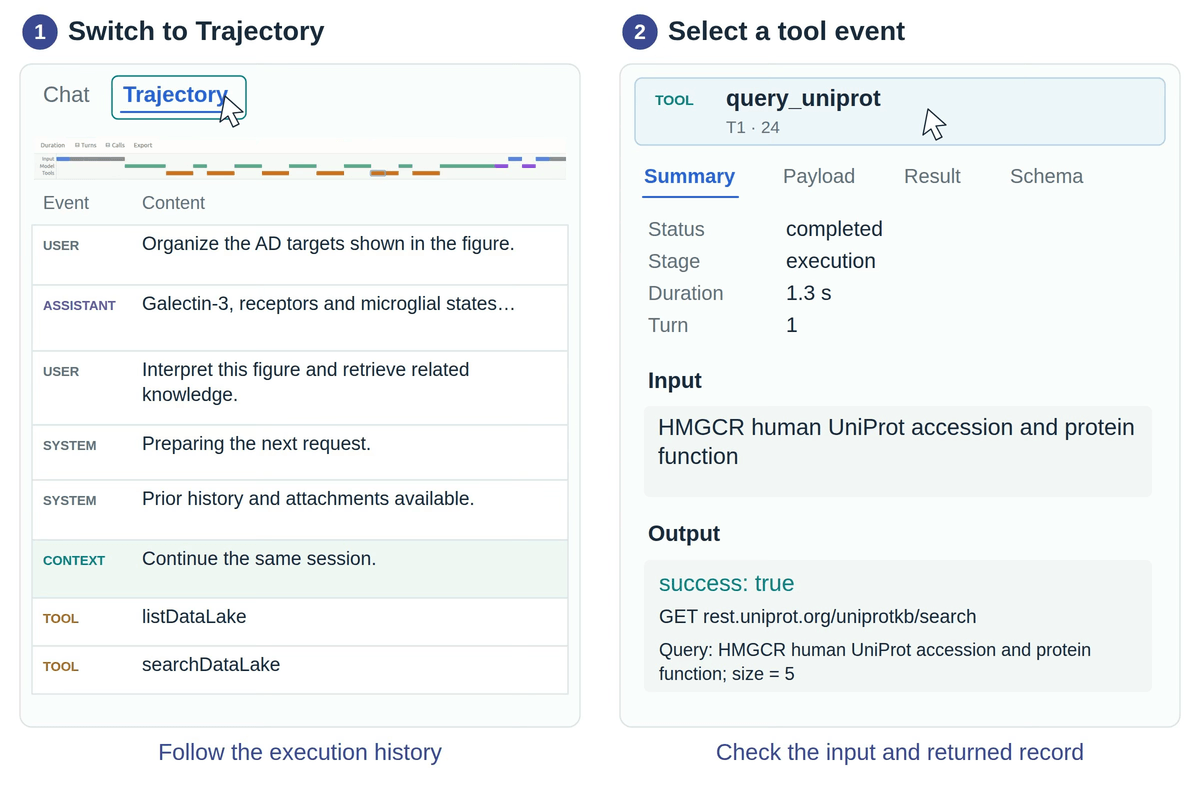
A researcher can upload a figure and ask the agent to interpret it, retrieve literature and protein information to connect claims with evidence, and narrow the scope or request a different comparison. The work behind each response stays visible: Compute shows execution activity, Results collects generated files, and Trajectory records each tool call with its inputs and outputs.
"Science is not only an application for AI. It can also be the environment in which the next generation of models learns," said Yingcheng Wu, co-founder and CEO of PhAI Labs. "With ScienceBuddy, the questions researchers ask and the corrections they make become part of how the system improves, both in the procedures it follows and in the model itself."
ScienceBuddy uses two learning loops. In the inner loop, the task model stays fixed while an auxiliary model identifies failures and proposes limited changes to the harness, the software layer that organizes the agent's instructions, skills and context. A candidate harness is kept only if it performs better in paired evaluations on development tasks. In the outer loop, the harness stays fixed while the task model is trained with reinforcement learning using rubric-based rewards. The updated model and harness are then evaluated and deployed together.
Requests, replies, actions, observations, and artifacts from research sessions become executable tasks with their own evaluation criteria. Updates run in the background while the service remains available, and each deployment gathers interactions for the next cycle.
The technical report evaluates the approach using 895 tasks across four scientific task families: literature reading and evidence retrieval (LitQA2), database judgments and queries (DbQA), protocol troubleshooting and analysis (ProtocolQA), and gene and variant assessment drawn from genome-wide association studies (GWAS), which examine how genetic variants relate to traits and disease.
Starting with Qwen3.5-4B as the task model, the study ran three recursive improvement cycles, each consisting of 10 harness evolution steps followed by 20 reinforcement learning updates. Single-attempt accuracy on the held-out test set rose from 42.2% to 73.3%. On that set, 33.3% of tasks changed from incorrect to correct, while 2.2% changed from correct to incorrect.
The report also examines each loop independently. With model weights fixed, harness adaptation raised validation accuracy from 31.1% to 51.1%. With the harness fixed, reinforcement learning raised problem coverage, measured by pass@4, from 48.3% to 67.8%. Pass@4 measures whether a problem is solved within four attempts.
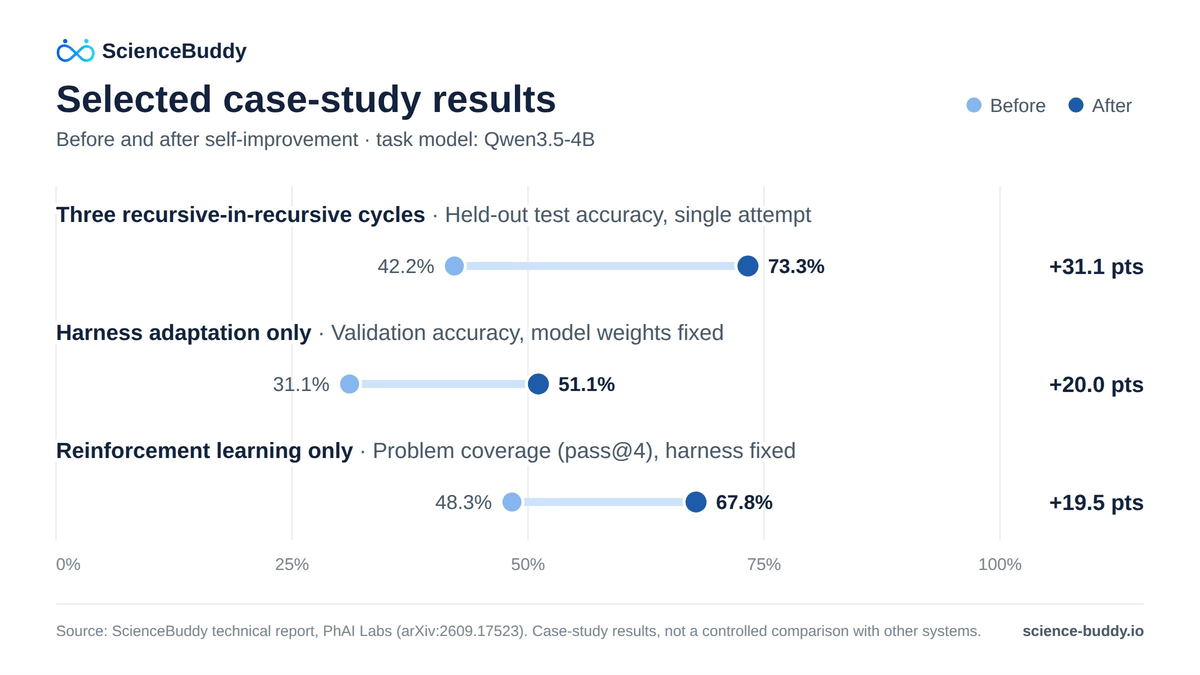
These findings are case study results rather than a controlled comparison with other systems. The project repository documents the current experimental configuration and reproduction steps.
The case studies began with two researcher sessions in the deployed workspace. One refined a JAK1 analysis into an ordered, gene-focused study plan. The other defined requirements for turning ARL4C manuscript results into an evidence-linked presentation. The report uses those sessions to show how a researcher's request can become task objectives, evaluation criteria and required outputs for the next learning cycle.
ScienceBuddy Preview is available in the browser at science-buddy.io. The technical report, PhAI Labs Technical Report PHAI-TR-2026-02, is available on arXiv (arXiv:2609.17523). Research code for the self-improvement experiments, including a simplified agent implementation and reproduction guides, is open source under the MIT License on GitHub.
About PhAI Labs
PhAI Labs develops model and data infrastructure for scientific discovery. The company brings scientific questions, data and experimental feedback into next-generation AI systems, with the goal of advancing AI from assisting research to participating in discovery. PhAI Labs was co-founded by Yingcheng Wu, CEO; Zhenfei Yin, president; and Ling Yang, chief scientific officer. Its core team includes members from Tsinghua University, Peking University, Stanford University, Princeton University, the University of Oxford, the University of California, Berkeley, MIT, ByteDance Seed and Google DeepMind. More information is available at phai-labs.com.