PapersOwl Survey Finds 77% of US Gen Z Identify With Soft Hermitting, Citing Cost Over Mental Health

New survey of 3,000 Americans aged 18 to 28 finds JOMO beats FOMO by two to one, while the widely discussed dumb phone trend is used regularly by just 9%.
UNITED STATES — October 2026 — PapersOwl surveyed of 3,000 Americans aged 18 to 28 suggests that several popular terms describing Gen Z's preference for doing less — including JOMO, soft hermitting, the analog bag and the dumb phone — reflect real behaviors, although the reasons behind those behaviors may be different from how they are commonly portrayed.
According to the survey, 77% of respondents said soft hermitting — deliberately turning down plans in favor of staying home — sounds like them, while only 9% rejected the description outright.
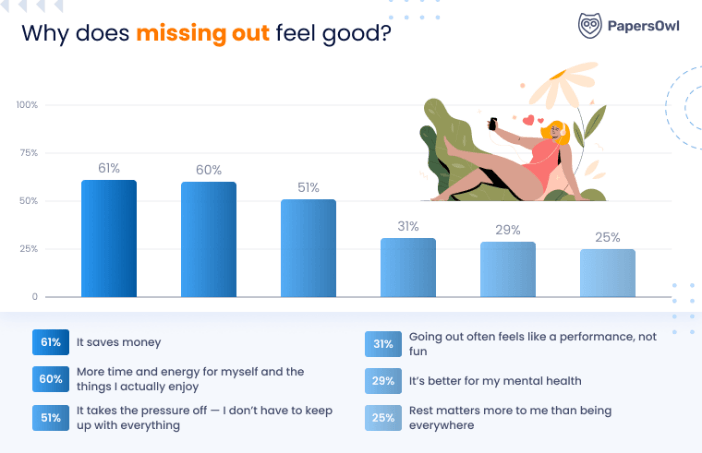
However, when respondents were asked why they opt out of social plans, financial and practical considerations ranked ahead of mental health. Among respondents who actively enjoy missing out, 61% said staying home saves money, while 60% said it gives them back time and energy. Only 29% described the decision as primarily related to mental health.
“Money is the loudest reason in the entire study. People are not withdrawing from social life, they are budgeting it,” said Jamie Thompson, Director of Cultural & Behavioral Insights at PapersOwl. “The mental health framing gets the coverage, but only 29% of our respondents described it that way. The economics are doing most of the work.”
JOMO Outpaces FOMO
The survey found that JOMO (Joy of Missing Out) has overtaken FOMO (Fear of Missing Out) by roughly two to one. Half of respondents, or 50%, said they feel fine or good about missing out, compared with 27% who said they feel anxious or disappointed.
The findings indicate that staying home is not necessarily viewed as social withdrawal. Instead, many respondents appear to be making deliberate choices about how they spend their money, time and energy.
Depletion Is a Leading Reason for Staying Home
Among respondents who choose to stay home, 55% said socializing drains them, while 50% said they genuinely like being at home. Cost was cited by 42%, and 32% said they were burned out from work or school.
The survey also found that activity-based socializing has become particularly popular. 51% of respondents actively choose low-pressure hangouts built around an activity, while another third said they prefer them in certain situations. Only 5% said they would rather have a conversation-first social experience.
Analog Bags Are More Popular Than Dumb Phones
The research also examined the relationship between Gen Z and screen-free activities.
51% of respondents said they regularly or sometimes carry an “analog bag” containing a screen-free activity such as a book, journal, crossword puzzle or sketchbook. Among those respondents, 41% said the goal was to rebuild their attention span, while only 9% said the aesthetic itself was part of the appeal.
By comparison, the much-discussed dumb phone trend appears to have limited adoption. Just 9% said they regularly use a basic handset, while 22% have considered one but never acted on the idea. Another 44% said they have never considered using one.
Money Emerges as a Recurring Factor
Financial pressure appeared repeatedly throughout the survey.
Among respondents who actively enjoy missing out, 61% said it saves money. Money was also identified as the leading cause when respondents were asked about experiencing an emotional breaking point during the summer, with 58% naming it as a contributing factor.
Heat and poor sleep followed at 46%, while comparison pressure was cited by 43%.
“When we asked what tipped people over the edge, the bill beat the weather,” Thompson said. “Six out of 10 respondents named money, against 46% for heat and bad sleep and 43% for comparing themselves to other people. Every version of this story gets told as burnout. Our respondents told it as an affordability problem, over and over, in four different questions.”
Men and Women Describe the Trend Differently
The survey found broadly similar levels of opting out among men and women, but differences emerged in how respondents explained their choices.
Among people who soft-hermit, 50% of men said going out costs too much, compared with 35% of women. Meanwhile, 61% of women said socializing drains them, compared with 50% of men.
Men were also more likely to say they choose activity-based hangouts because they are cheaper and to describe screen-free time as a way to repair their attention span.
Women were more likely to describe offline time in terms of feeling calmer and more present.
One finding ran against the expected pattern: when asked why missing out feels good, 38% of men cited mental health compared with 18% of women.
“The stereotype is that women medicalise their social lives and men shrug,” Thompson said. “Our data runs the other way on that specific question. Men gave the mental health answer twice as often. The framing split is real, but anyone treating it as a clean rule will get it wrong.”
A Generation Rationing Social Life Rather Than Abandoning It
Overall, the findings do not suggest that Gen Z is becoming entirely antisocial or retreating from social life.
Instead, the survey points to three recurring constraints: money, energy and attention.
With 82% of respondents open to activity-based hangouts and only 5% preferring the conversation-first alternative, the results suggest that social interaction remains important but is increasingly shaped by practical considerations.
For many respondents, social life appears to be something they budget rather than something they simply do.
Methodology
PapersOwl surveyed 3,000 Americans aged 18 to 28 residing in the United States in August 2026. Respondents were recruited through Random Device Engagement. The study did not target specific ethnicities or social backgrounds.
Percentages are rounded to the nearest whole number. Questions permitting multiple answers may total more than 100%.
About PapersOwl
PapersOwl is an academic support platform used by students in the United States and internationally. Its Insights programme publishes original survey research examining student behavior, work and digital culture.
For additional data cuts, including gender, age-band and regional findings, and full question wording, contact the PapersOwl press team.