
Global Data Route Analytics releases autoinjectors market study projecting USD 48,029.60 million by 2035
New market study examines autoinjector demand and capacity
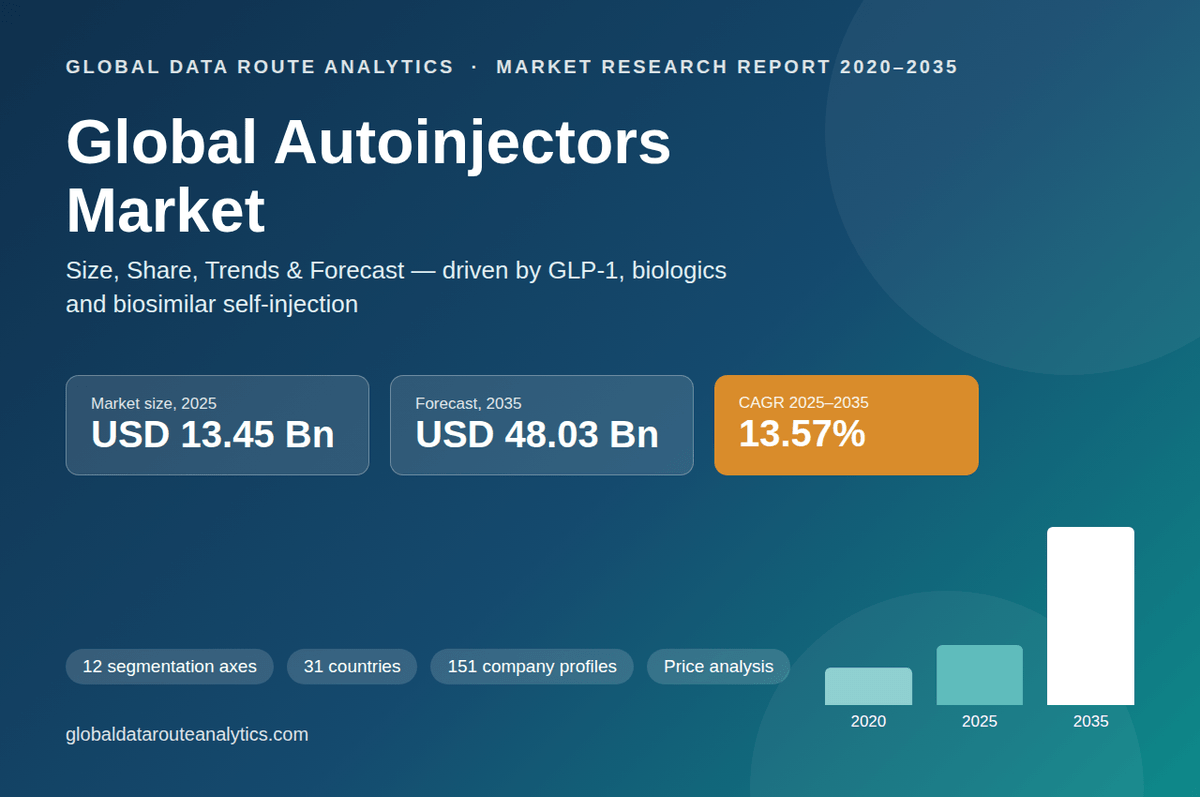
Global Data Route Analytics released a new study, Global Autoinjectors Market Size, Share, Trends & Forecast 2020–2035, on September 16, 2026. The 1,750-page report values the global autoinjectors market at USD 13,451.97 million in 2025 and projects it to reach USD 48,029.60 million by 2035, a compound annual growth rate (CAGR) of 13.57%. The market stood at USD 8,420.00 million in 2020, meaning revenue will have expanded more than five-fold across the fifteen-year study period.
The report's central finding is that the autoinjector has moved from an accessory to the drug to the constraint on how fast the drug reaches patients. The multi-year U.S. shortages of semaglutide and tirzepatide were resolved only after manufacturers demonstrated national-scale device capacity, and the World Health Organization's 2025 addition of GLP-1 receptor agonists to its Essential Medicines List extends that demand to health systems worldwide.
Regional and segment findings
North America is the largest regional market at USD 6,100.47 million in 2025, rising to USD 21,813.81 million by 2035 at a 13.59% CAGR, supported by the deepest biologic and GLP-1 prescribing base and mature combination-product regulation. Asia-Pacific is the fastest-growing region at a 14.12% CAGR, from USD 2,811.46 million to USD 10,534.69 million, on expanding healthcare infrastructure and localized device manufacturing in China and India. Europe follows at USD 3,286.32 million in 2025, reaching USD 11,482.60 million by 2035.
Single-use and disposable devices generate 97.1% of 2025 revenue, while reusable autoinjector systems are the fastest-growing device category at a 14.69% CAGR as circular and electromechanical platforms reach market. Monoclonal antibodies and fusion proteins account for roughly 61% of revenue by drug modality; home and self-care settings represent about 68% of revenue and reach USD 33,752.72 million by 2035. Endocrinology, metabolic and hormonal disorders, the therapy area covering diabetes, obesity and chronic weight management, is the fastest-growing of twelve therapy areas at a 14.29% CAGR, reaching USD 11,116.53 million by 2035.
Inquiries regarding the report, individual company profiles, segments or countries may be submitted at https://globaldatarouteanalytics.com/report/1690/global-autoinjectors-market/inquiry.
Drivers and capital deployment
Demand rests on a chronic-disease base that continues to expand. The IDF Diabetes Atlas (11th edition) counts 589 million adults living with diabetes today, projected to reach 852.5 million by 2050, with China, India and Indonesia alone accounting for 50.5% of the world's undiagnosed cases. GBD 2021 projects rheumatoid arthritis prevalence to grow 80.2% to 31.7 million by 2050, and the WHO expects the population aged 60 and over to double to 2.1 billion by 2050, precisely the cohort for whom a one-button, needle-shielded device outperforms a vial and syringe.
Manufacturers have responded with historic capital deployment. Novo Nordisk's capital expenditure reached DKK 60.1 billion in 2025. BD committed USD 110 million to expand glass prefillable-syringe production in Nebraska. Ypsomed grew commercial autoinjector sales 33.6% while building toward one billion devices of installed annual capacity. SHL Medical opened a USD 220 million, 360,000-square-foot autoinjector facility in North Charleston, South Carolina. Adjacent expansion is arriving from two directions: IV-to-subcutaneous conversion, led by the first subcutaneous PD-1 inhibitors, is pulling oncology onto injector-compatible formats, while a biosimilar pipeline of 90 U.S.-approved products, with interchangeability increasingly granted at the level of the individual autoinjector presentation, multiplies device volume without new-molecule risk.
Restraints and challenges
The report examines the forces working against adoption: high-profile device recalls by the U.S. FDA and UK MHRA over devices that failed to activate or required excess activation force; pricing scrutiny that runs from the 2016 EpiPen congressional hearings to CMS's negotiated 2027 Medicare price of USD 274 per month for Ozempic against a USD 959 list price; the approval of the first needle-free epinephrine nasal spray as a route-of-administration substitute; counterfeit GLP-1 pens seized inside the legitimate U.S. supply chain; and manufacturing-capacity bottlenecks across primary containers, elastomers and assembly. A dedicated ten-dimension price-analysis chapter compares list, net, pharmacy-acquisition, government-negotiated and consumer cash prices for autoinjector-delivered therapies.
Autoinjectors market by region, 2025 vs 2035 (USD Million): North America leads; Asia-Pacific grows fastest at 14.12% CAGR.
Report scope and company profiles
Rather than a short key-players list, the report profiles 151 companies across 15 dedicated chapters spanning the full value chain: autoinjector device manufacturers (SHL Medical, Ypsomed, Owen Mumford, Phillips-Medisize, Haselmeier, Nemera, Elcam Medical); platform and injection-technology companies (Gerresheimer, SMC Ltd., Enable Injections, Credence MedSystems, Crossject, PharmaJet); pharma companies using autoinjector platforms (Novo Nordisk, Eli Lilly, Sanofi, AbbVie, AstraZeneca, UCB, Teva); emerging epinephrine innovators (Kaleo, ALK-Abelló, Pirouette Pharma, EpiSafe, Rx Bandz); biosimilar and specialty-injectable companies (Celltrion, Samsung Bioepis, Fresenius Kabi, Viatris, Lupin); primary-container and CDMO partners (West Pharmaceutical Services, BD, SCHOTT Pharma, Nipro, Terumo, Recipharm, Catalent, Vetter Pharma); and connected-device, safety-syringe, automation and regional emerging-market companies. Each profile covers company details, financials, product summary and recent developments.
Recent developments tracked include embecta's acquisition of Owen Mumford with up to £50 million tied to Aidaptus autoinjector sales, FDA approval of AstraZeneca's Saphnelo Pen for once-weekly self-administration, Haselmeier's PiccoJect entering clinical trials, Ypsomed's launch of the YpsoLoop circular platform, Gerresheimer and Portal Instruments' expanded collaboration on the PRIME Nexus reusable electromechanical autoinjector, and Kindeva Drug Delivery's contract worth up to USD 129 million to supply DuoDote autoinjectors to the U.S. Strategic National Stockpile.
The 1,750-page study quantifies revenue in USD million for 2020–2035 across twelve segmentation axes, 17 sub-segmentations and more than 120 categories: device reusability, drug-container architecture, nominal capacity, drive mechanism, dose configuration, connectivity, route of administration, therapy area (12 areas, 40+ indications), drug modality, end-use setting, administrator type and region, with country-level breakdowns for 31 countries and sub-regions across North America, Europe, Asia-Pacific, Latin America and the Middle East & Africa. Analytical frameworks include drivers, restraints, opportunities and challenges with sourced indicators, SWOT, PESTEL, Porter's Five Forces, regulatory and investment scenarios, and COVID-19 recovery analysis. Deliverables include a 700+ table PDF and an Excel data pack with verified company and product links.
About Global Data Route Analytics
Global Data Route Analytics is a market research and consulting firm delivering syndicated and custom research across healthcare, life sciences, medical devices and adjacent industries. Its reports combine primary interviews, verified secondary sources and proprietary estimation models to give manufacturers, investors and policy teams a quantified basis for decisions. The complete report is available at https://globaldatarouteanalytics.com/report/1690/global-autoinjectors-market.