EFPAFootball.com Broadens Coverage of European Football for the 2026/27 Season

EFPAFootball.com, an independent football news and editorial website, has expanded its editorial coverage to combine its established archive of European player profiles with regular reporting on current players, competitions, clubs, managers and supporters. The expansion, introduced across September 2026 and continuing through the autumn, gives readers one place to follow both the history of the European game and the stories shaping it today.
The publication now organises its work across dedicated sections for players, retired players, clubs, managers, competitions and fans, alongside a news section and a general blog. New features are added throughout each month, while the site's existing library of player profiles continues to grow country by country.
EFPAFootball.com launched in 2021 under the name European Football Pro Allstars (EFPA). The original purpose of the site was straightforward: to document the careers of notable European footballers in a consistent format that readers could return to and compare. Each profile set out a player's clubs, key statistics, major awards and honours, and the background that shaped their career.
Over time, readers began using the profiles as a starting point for wider questions. How did a player's career compare with that of a rival from a different decade? What happened to them after they retired? Which clubs came close to signing them before they moved elsewhere? Those questions shaped the decision to broaden the site's editorial scope beyond reference profiles and into features, analysis and news.
"The profiles were always the foundation, and they still are," said Paul Eddison, Founder at EFPAFootball.com. "What changed was how people used them. Readers would arrive at a profile and then want to know the story around it. The expansion is really a response to that. We wanted to give the history somewhere to connect to, so that someone reading about a player from the 1950s can move naturally into a piece about a teenager breaking into a first team this season."
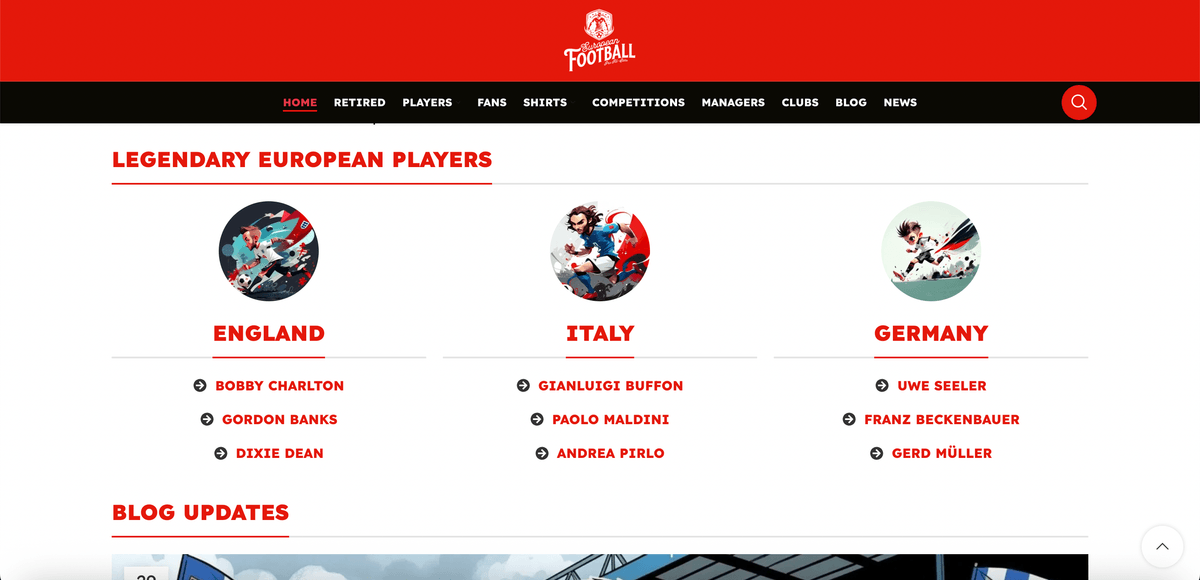
The All Star player profiles remain central to the publication. Profiles are grouped by nation, with sections covering England, Italy, Germany, Spain, Portugal, France and Northern Ireland among others.
The English section includes Bobby Charlton, Gordon Banks and Dixie Dean. Charlton's profile records that he signed for Manchester United on 1 January 1953 at the age of 15, the beginning of a career that would make him one of the most recognised figures in the English game. The Italian section covers Gianluigi Buffon, Paolo Maldini and Andrea Pirlo, while the German section includes Uwe Seeler, Franz Beckenbauer and Gerd Müller.
Further profiles cover players such as Andrés Iniesta of Spain, whose vision and passing made him a central part of Barcelona's style of play, and Luís Figo of Portugal, who played street football as a child before joining Sporting Lisbon's academy at the age of 12. Profiles of George Best, Eric Cantona and Nat Lofthouse are also included.
Each profile follows a consistent structure, covering clubs, statistics, honours, quotes and background facts, with video material added where available. The consistent format allows readers to compare careers across eras, positions and countries.
"Consistency matters when you are writing about players whose careers are separated by seventy years," said Paul Eddison. "The game, the fixture lists and the way records were kept have all changed. We try to present each career fairly within its own era, so that readers can draw their own conclusions."

One recurring theme in the site's coverage is the long running argument over which player deserves to be called the GOAT, an abbreviation for "greatest of all time." While the modern version of the debate is usually framed around Lionel Messi and Cristiano Ronaldo, EFPAFootball.com's coverage traces the argument back more than a century.
In the 1920s and 1930s, supporters in England argued over the merits of Dixie Dean and Billy Meredith. By the 1950s, the comparison had moved to Stanley Matthews and Nat Lofthouse. In the 1960s, as European competition brought players from different countries into direct contact, the debate took on an international character, with supporters comparing George Best of Northern Ireland and Eusébio of Portugal.
The site uses this history to give context to current debates, showing how standards of comparison have shifted as the game has become faster, more tactical and more widely televised.
The most visible part of the expansion is regular coverage of current players, clubs and competitions. The Competitions section and the players, clubs and managers sections now publish new features on a rolling basis.
Recent coverage has included a profile of Will Grainger, the Sheffield Wednesday youngster who, at 16, went from expecting to watch the club from the stands to finding himself on the pitch. The piece follows the experience of a young supporter moving into the professional game at the club he grew up following.
A clubs feature revisited the summer of 2003, when Manchester United manager Sir Alex Ferguson publicly indicated that the club was close to signing Ronaldinho, before the Brazilian moved to Barcelona instead. The article examines how the transfer developed and how both clubs' fortunes might have looked had it gone the other way.
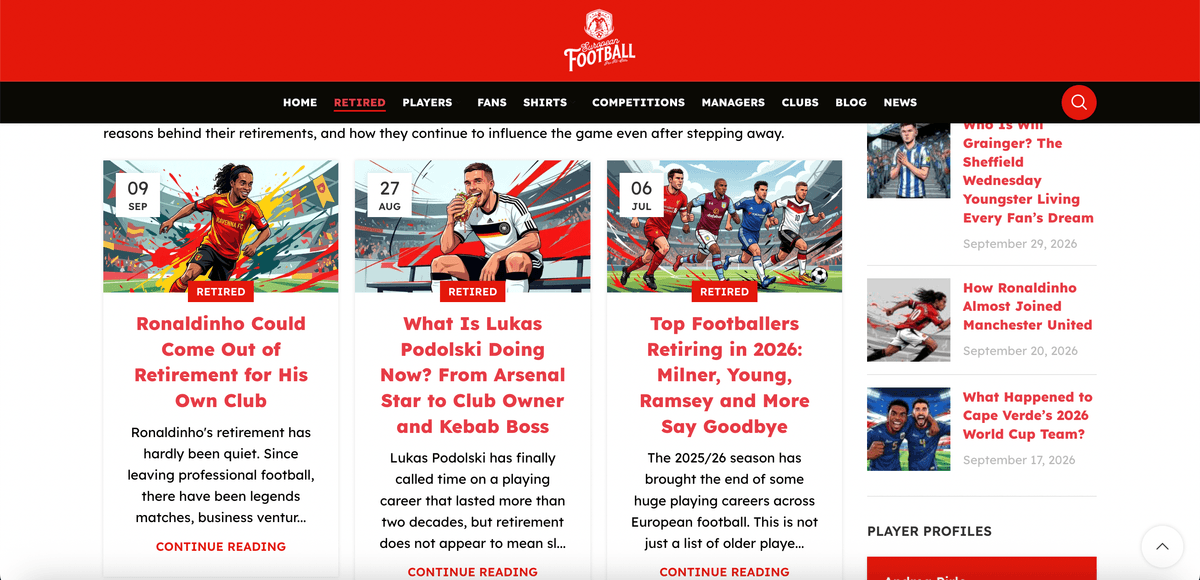
Other features have compared famous father and son pairings in professional football, including the Haaland family, and asked whether the son's career surpassed the father's in each case. The retired players section has also covered reports that Ronaldinho could return to playing for a club he owns.
A distinctive part of EFPAFootball.com's coverage is its focus on what happens to footballers once their playing careers end. The Retired section follows former players into business, broadcasting, coaching, charitable work and the arts.
For many players, the transition away from professional football is difficult. Careers often end in a player's mid thirties, and the routine, structure and public attention of professional sport disappear quickly. The site's coverage looks at how different players have approached that change.
The Fans section covers the relationship between supporters and the game, including the clubs followed by public figures from outside football. Recent articles have looked at which clubs are supported by broadcaster David Attenborough and by actor and comedian Tracey Ullman, examining the evidence behind commonly repeated claims.
These pieces aim to check popular assumptions against available sources rather than repeat them. Where the evidence is unclear or contradictory, the articles say so.
EFPAFootball.com operates as an independent publication. Its editorial approach centres on researched profiles and context rather than transfer rumour or speculation. Articles are written to be accessible to casual readers while remaining useful to committed supporters.