
Crescent Bioresearch KPV 10 mg Certificate Reports 207.9 EU of Endotoxin per Vial Against a 350 EU Limit, Tested at 0.005 EU/mL
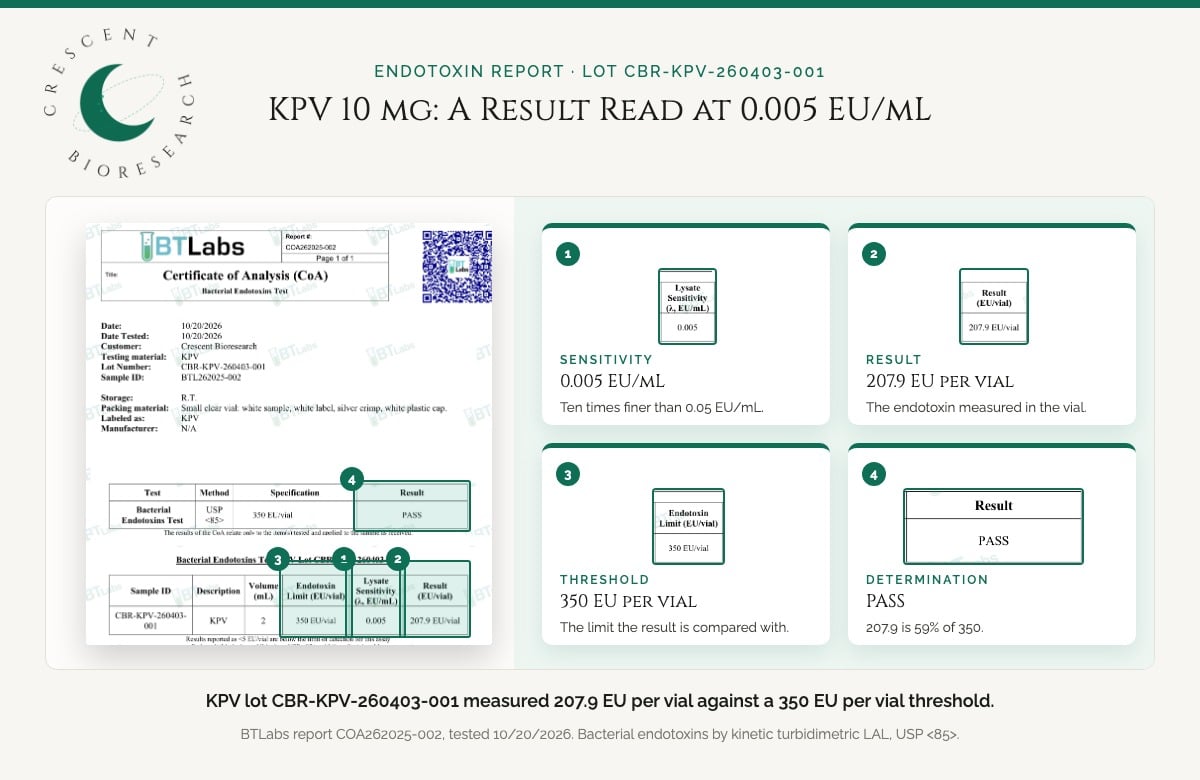
ALBANY, N.Y., Oct. 30, 2026 -- Crescent Bioresearch, a supplier of laboratory compounds, has published the endotoxin result for its current lot of KPV as a measured number that supports the result. The certificate for lot CBR-KPV-260403-001 reports 207.9 endotoxin units per vial against a threshold of 350, a lysate sensitivity of 0.005 EU/mL and a test volume of 2 mL. A 'pass' is printed along with the numerical endotoxin value, lysate sensitivity, and the threshold used to determine the pass. All four parameters were required in order to validate the endotoxin report.
The compound
KPV is the tripeptide lysyl-prolyl-valine, written Lys-Pro-Val, registered under CAS 67727-97-3. It corresponds to the last three residues of alpha-melanocyte-stimulating hormone, which is why the literature also calls it alpha-MSH (11-13). Crescent Bioresearch supplies KPV as a 10 mg fill for laboratory research.
What was measured
BTLabs, an independent third-party laboratory in West Palm Beach, Florida, tested the lot on October 20, 2026, with the Limulus amebocyte lysate test, LAL, under United States Pharmacopeia General Chapter 85, Bacterial Endotoxins Test. Endotoxin is the lipopolysaccharide of Gram-negative bacteria. It survives sterile filtration and ordinary heat, and cultured cells respond to it at very low concentrations. The test reports it in endotoxin units, EU, a measure of activity against a reference standard.
For this lot the laboratory dissolved the vial in 2 mL and measured 207.9 EU per vial. The threshold was 350 EU per vial, so the lot sits at 59 percent of its limit. The determination is PASS.
Why the number matters more than the pass
A pass on this certificate means only that the result fell somewhere below 350 EU per vial. Every result from the bottom of the test's range up to that limit earns the same word. A lot at 5 EU and a lot at 340 EU would both be printed as PASS, though one carries nearly seventy times the endotoxin of the other.
That spread is the reason the measured value is printed. A research entity does not work at the laboratory's threshold. It works at its own concentration, in its own cells, against its own tolerance for contamination, and it can only reach those figures from a number.
For this lot the arithmetic is direct. Across the 10 mg fill, 207.9 EU comes to 20.79 EU per milligram, or about 0.021 EU per microgram. Those are the figures a research entity multiplies by the amount of material in each condition of an experiment to know how much endotoxin that condition carries. A certificate that printed only PASS would leave every one of those figures unknown.
Why the sensitivity is printed beside it
The lysate sensitivity is the smallest concentration the test can detect. On this report it is 0.005 EU/mL, ten times finer than the 0.05 EU/mL used on several other lots. The sensitivity describes the test, not the vial, and it is printed separately from the result so that the two cannot be confused.
The sensitivity matters most when a result is low. A lot reported as below 5 EU per vial is reported at the edge of what its test could see; the true figure could sit anywhere beneath it. At 207.9 EU per vial this KPV lot is far above its detection limit, so the value is a measurement in the full sense, not a ceiling.
What a number makes possible
A measured value can be compared. When the next lot of KPV is tested, its result can be set beside 207.9 and the difference read directly. Two passes cannot be compared at all.
A measured value can also be traced. If an experiment produces a response that does not repeat, the endotoxin carried into each run is one of the first variables to rule out. With a figure per milligram, a research entity can calculate that load for every condition it ran. Without one, endotoxin stays an open question in any analysis.
The full record
The certificate also reports identity by FTIR under USP General Chapter 197A and purity by HPLC under USP General Chapter 621, both for lot CBR-KPV-260403-001, on a separate signed report. Each endotoxin figure is labeled where it sits on the page in the annotated endotoxin report. Every current certificate is held in the Crescent Bioresearch certificate library, and the KPV COA is published before the lot is listed.
SUPPLEMENTARY DATA
United States Pharmacopeial Convention. General Chapter <85> Bacterial Endotoxins Test. United States Pharmacopeia and National Formulary.
Certificate of analysis, lot CBR-KPV-260403-001: BTLabs report COA262025-002 (bacterial endotoxins, tested October 20, 2026) and report COA261773-001 (purity and identity). crescentbioresearch.com/coa/CBR-KPV-260403-001
Annotated endotoxin report, lot CBR-KPV-260403-001. crescentbioresearch.com/coa/CBR-KPV-260403-001/annotated
Chemical identifier: KPV, L-lysyl-L-prolyl-L-valine, CAS 67727-97-3, PubChem CID 125672.
FREQUENTLY ASKED QUESTIONS
What is the endotoxin result for KPV lot CBR-KPV-260403-001? 207.9 EU per vial against a threshold of 350 EU per vial, which is 59 percent of the limit, with a determination of PASS. For the 10 mg fill that is 20.79 EU per milligram.
Is the sensitivity the endotoxin result? No. The sensitivity, 0.005 EU/mL, is the smallest amount the test can detect. The result, 207.9 EU per vial, is what the test found. It's important to differentiate between the two when analyzing a report.
Why print the number if the lot passed? A pass covers every result below the limit. The number places this lot within that range, so it can be converted, compared and checked against a research entity's own limit. It is not possible to determine whether a material had passed without a definitive numerical endotoxin value.
Does a finer test sensitivity change the result? No. A finer sensitivity allows the test to detect smaller amounts. It does not raise or lower the endotoxin that is in the vial.
ABOUT CRESCENT BIORESEARCH
Crescent Bioresearch is a supplier of laboratory compounds, founded around a framework of critical assessment. It works with research entities nationwide in pursuit of preserving the integrity of scientific research through its transparency approach. Follow the Crescent Discovery Series to dive into the latest breakthroughs and findings within prominent literature.