Beyond AI Generation: How Creative Workflows Are Shaping the Next Phase of AI Software

Artificial intelligence has lowered the barriers to creating images, videos, and other visual content. Tasks that once required specialized skills and complex production software can now begin with a simple prompt. As generation becomes more accessible, AI software companies face a broader business question: how do they create lasting value when producing an individual asset is no longer the only differentiator?
The answer increasingly lies in the workflow surrounding generation. Beyond producing content, creators need to compare alternatives, refine concepts, organize assets, and decide which ideas deserve further investment. For AI software companies, and the investors watching them, these activities are an opening to build products around the creative process rather than a single model or output.
The Business Challenge Beyond AI Generation
A generated image or video is usually one step in a larger project. Designers test several visual directions before selecting a concept. Video creators experiment with characters, scenes, and styles before assembling a consistent sequence. Marketing teams produce multiple campaign ideas and evaluate them against a shared brief. Each of these tasks involves judgment, iteration, and organization, and often collaboration among people working with different references, prompts, and versions of an asset.
Adobe’s 2026 Creators’ Toolkit Report, based on a survey of more than 16,000 creators across eight countries, offers context for this shift. Among creators who use or have tried creative AI, 75% describe it as integrated or essential to their workflow. Yet 85% believe the final creative decision should remain with the creator, and 57% say AI-generated outputs typically require moderate or extensive editing before they are ready to share.
These findings point to a gap between generating possibilities and turning them into finished work. As generation capabilities spread across products, the surrounding user experience becomes a more important source of differentiation. That does not require a single platform that does everything. It means finding where users encounter friction and determining whether better organization, iteration, or collaboration helps them complete their work.
Creative Workflows as a Product Opportunity
AI creative software serves users with different priorities. Some want accessible tools that generate images and videos quickly. Others want configurable workflows with more control over how models and production steps connect. Pollo AI illustrates the appeal of bringing multiple generation capabilities into an accessible product experience. RunningHub, with its ComfyUI ecosystem and configurable workflows, serves users who want greater control over how production processes are assembled. Neither is a universal solution, and specialized tools will keep their place for users who prioritize a particular model or a tightly defined production function.
A further opportunity sits between initial generation and final production: keeping references and outputs together, comparing alternatives, and maintaining context as an idea evolves. Its commercial value depends on practical usefulness. A more connected workspace has to reduce the effort of reviewing options and coordinating a project in a way that fits the user’s actual process, because added features alone do not guarantee stronger retention.
CreaXene AI: Building Around the Creative Process
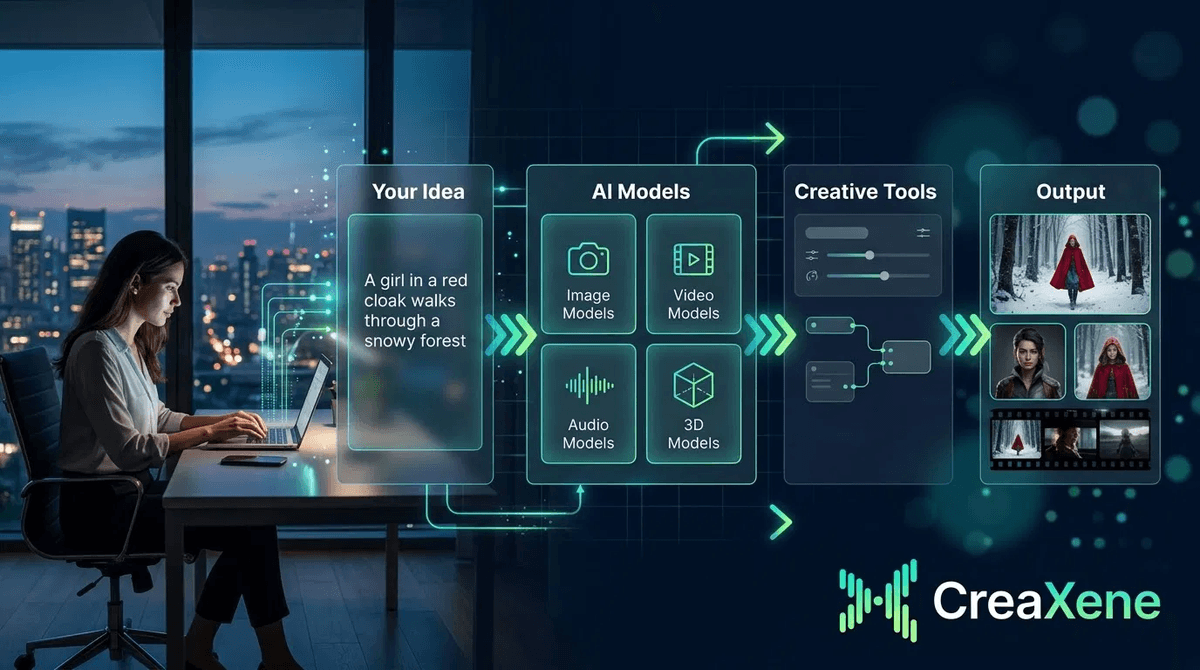
CreaXene AI builds its product around this workspace approach. The platform combines an infinite canvas, Quick Creation tools, and multi-user collaboration to support visual exploration and creative development.
The infinite canvas brings prompts, references, generated assets, and emerging concepts into one visual environment. Instead of reviewing every result in isolation, creators compare directions side by side and preserve context as their ideas develop. Quick Creation helps users move from an initial idea to visual output through a streamlined set of steps, which makes early experimentation easier. Multi-user collaboration gives teams a shared space to review concepts and develop ideas together.
CreaXene AI has surpassed 100,000 registered users as of September 2026. Its product direction rests on a simple view: generation is a starting point, and the work around it deserves equal attention.
“The canvas isn’t just a place to store results. It’s where the real creative judgment happens. We’ve watched creators test directions side by side and only then move the strongest idea into production,” said Jasper Chan, Business Development Lead at CreaXene AI.
The distinction matters. A workspace does not replace the underlying generation technology. It gives users an environment to evaluate and develop what that technology produces.
What Workflow-Centric Software Means for Growth
For AI software companies, workflow design offers a way to define product value beyond a new model release or feature. As users gain more generation options, the experience of using them influences which products they return to.
Consider a creator developing a short-form video. Generating a scene is one task; choosing a visual direction, comparing alternatives, maintaining consistency, and incorporating feedback are others. A product focused only on generation covers one part of that process, while a workspace that connects several of these activities supports a broader set of needs. The same holds for design and marketing teams that explore multiple concepts before committing resources to a direction.
For businesses, the test is measurable outcomes: repeat usage, project completion, conversion to paid plans, collaboration activity, and retention. These show whether workflow features create sustained value or simply add complexity.
The Next Phase of AI Creative Software
Progress in AI creative software will continue to depend on model quality, speed, and cost. Yet generation alone is unlikely to decide which products become part of a creator’s everyday work.
As more platforms offer capable generation features, software companies need to understand the tasks users are trying to complete around those capabilities. Products that help people organize ideas, compare possibilities, collaborate, and refine outputs have another way to differentiate themselves, provided those features solve real problems.
CreaXene AI is pursuing this opportunity through a creative workspace that brings visual exploration and collaboration into one environment. Its approach reflects a wider question for AI software companies: as creating an initial output becomes easier, how can products help users turn that output into something worth developing?
Explore CreaXene AI at https://creaxene.ai.
About CreaXene AI
CreaXene AI is an AI-powered creative platform focused on visual creation and creative exploration. Its infinite canvas, Quick Creation tools, and collaborative capabilities provide an environment for individuals and teams to develop ideas and explore visual possibilities.